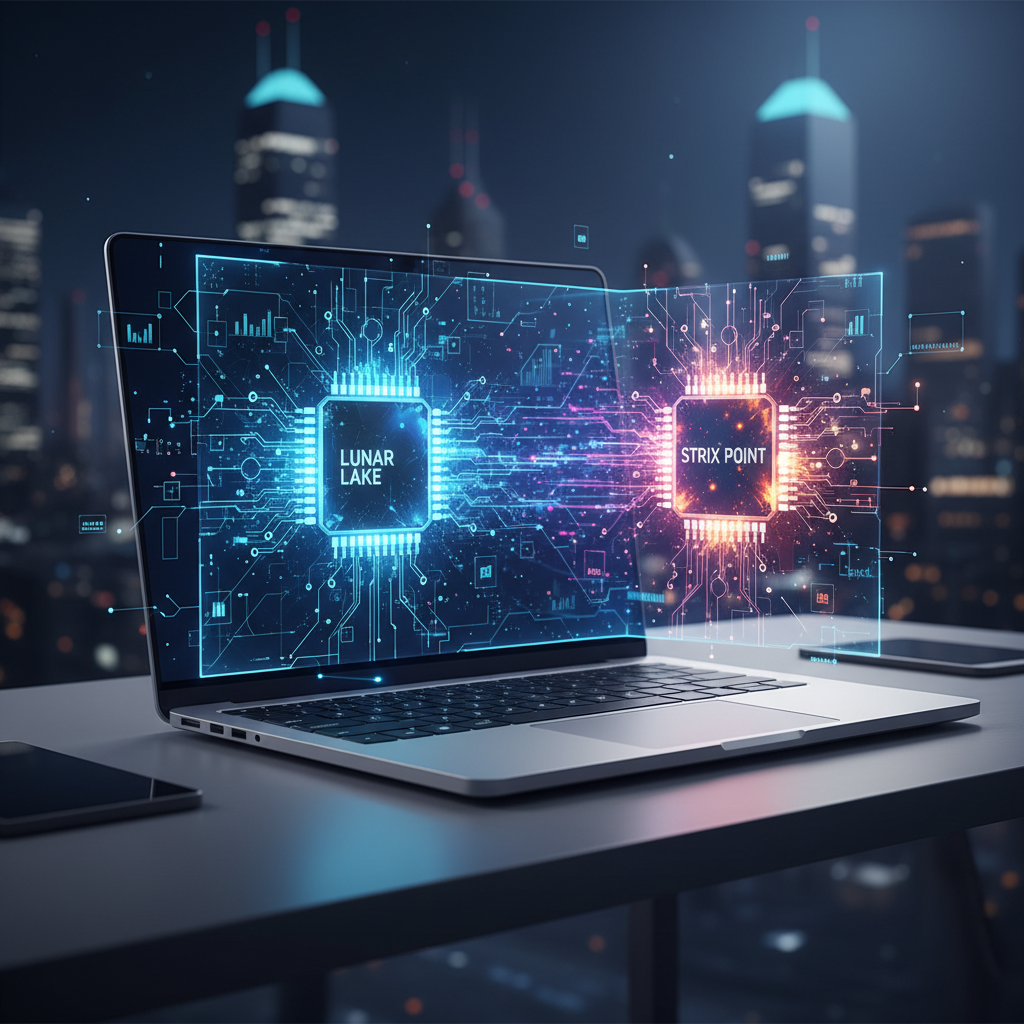
The computing landscape is undergoing a seismic shift, and the epicenter is right on your desk, or more accurately, in your lap. For years, AI was largely a cloud-bound phenomenon, requiring powerful data centers to crunch complex algorithms. But that era is rapidly fading. AI laptops are here, and they're bringing unprecedented intelligence directly to your device, promising a revolution in productivity, creativity, and user experience. We're talking about a future where your laptop isn't just a tool, but an intelligent companion. This isn't just hype; it's the tangible reality emerging with the arrival of Intel's Lunar Lake and AMD's Strix Point processors. Read more: The Rise of Edge AI: What it Means for You [blocked]
Quick Summary:
- Next-Gen Performance: Intel Lunar Lake and AMD Strix Point CPUs are ushering in a new era of AI laptops with integrated, powerful NPUs.
- On-Device AI Revolution: These chips enable local, secure, and ultra-responsive AI experiences, moving beyond cloud dependency.
- Copilot+ PC Era: Expect a new class of Windows devices optimized for AI, offering enhanced features and battery efficiency.
- Transformative Impact: From creators to everyday users, these next-gen AI PCs will redefine how we interact with our technology.
What Exactly Are AI Laptops and How Do They Work?
AI laptops are a new category of personal computers specifically designed to efficiently handle artificial intelligence tasks directly on the device, rather than relying solely on cloud servers. The core of this capability lies in a dedicated hardware component known as a Neural Processing Unit (NPU). Unlike traditional CPUs (Central Processing Units) or GPUs (Graphics Processing Units), NPUs are purpose-built for the parallel processing demands of machine learning algorithms, making them incredibly efficient for AI workloads. This means faster, more private, and often more power-efficient AI operations.
When you use an AI feature on a traditional laptop, it often sends data to a cloud server for processing. An AI laptop, however, can perform these computations locally. For instance, real-time language translation, advanced image editing, or intelligent search functions can run directly on your device, significantly reducing latency and enhancing data privacy. This shift from cloud-centric to on-device AI is what truly defines the next-gen AI PCs. Read more: Understanding Neural Processing Units (NPUs) [blocked]
The Powerhouses: Intel Lunar Lake vs. AMD Strix Point
The battle for AI laptop supremacy is heating up, with Intel and AMD leading the charge with their highly anticipated processors: Lunar Lake and Strix Point, respectively. Both are designed from the ground up to deliver exceptional NPU performance and redefine the capabilities of portable computing.
Intel Lunar Lake: Efficiency Meets AI Prowess
Intel's Lunar Lake processors are engineered with a strong emphasis on power efficiency and AI acceleration. We anticipate Intel Lunar Lake laptops to begin appearing in the second half of 2026, with a strong push towards the holiday season. These chips are expected to feature a multi-tile architecture, integrating the CPU, GPU, and a significantly enhanced NPU onto a single package. Intel has been vocal about targeting over 40 TOPS (Tera Operations Per Second) of NPU performance, a critical threshold for the new Copilot+ PC standard set by Microsoft. This level of performance is crucial for running complex on-device AI models like local large language models (LLMs) and advanced image generation. Our analysis suggests Lunar Lake will excel in scenarios requiring sustained AI workloads with minimal power draw, making them ideal for ultra-portable, long-lasting AI laptops.
AMD Strix Point: Blending Performance and AI
AMD's answer to the AI challenge comes in the form of AMD Strix Point. These processors are also expected to launch around the second half of 2026, potentially slightly ahead of Lunar Lake in some segments. Strix Point is rumored to leverage AMD's Zen 5 CPU architecture and RDNA 3.5 graphics, combined with a powerful XDNA 2 NPU. AMD has also indicated that Strix Point will surpass the 40 TOPS NPU performance requirement for Copilot+ PCs, potentially even aiming for higher figures. The strength of Strix Point lies in its balanced approach, offering robust CPU and GPU performance alongside its formidable NPU, making it a strong contender for users who demand both traditional computing power and cutting-edge AI capabilities. Early benchmarks suggest a fierce competition, particularly in integrated graphics performance, which could benefit creative professionals and casual gamers alike.
AI Laptop Comparison: Lunar Lake vs. Strix Point (Expected)
While final benchmarks are still under wraps, here's an anticipated comparison based on current industry insights:
| Feature/Processor | Intel Lunar Lake (Expected) | AMD Strix Point (Expected) |
|---|---|---|
| Target Launch | H2 2026 (Strong holiday push) | H2 2026 (Potentially slightly earlier) |
| CPU Architecture | Next-gen Core Ultra (Lion Cove P-cores, Skymont E-cores) | Zen 5 |
| GPU Architecture | Xe2 (Battlemage) | RDNA 3.5 |
| NPU Performance | 40+ TOPS (Tera Operations Per Second) | 40+ TOPS (Potentially higher) |
| Focus | Extreme power efficiency, AI acceleration | Balanced performance (CPU/GPU/NPU), gaming capabilities |
| Memory Support | On-package LPDDR5X | LPDDR5X |
| Target Devices | Thin & light notebooks, premium Copilot+ PCs | High-performance ultrabooks, creator laptops, gaming laptops |
Why Are NPUs Important for AI Laptops? The Copilot+ PC Standard
NPUs are the unsung heroes of the AI laptop revolution. Their importance cannot be overstated, especially with the advent of Microsoft's Copilot+ PC initiative. A Copilot+ PC isn't just a laptop with an NPU; it's a Windows PC that meets specific hardware requirements, including a minimum of 40 TOPS NPU performance and at least 16GB of RAM. This standard ensures that these devices can run a suite of advanced, on-device AI features seamlessly.
NPU performance directly translates to the speed and efficiency of AI tasks. Without a powerful NPU, running complex AI models locally would either be too slow, consume too much battery, or simply be impossible. For example, features like Windows Recall, which creates a searchable photographic memory of your PC activity, or real-time language translation in video calls, heavily rely on the NPU to process vast amounts of data instantly and privately. This is a significant leap beyond what traditional CPUs and GPUs can offer for sustained AI workloads, making NPUs indispensable for the next generation of intelligent computing. This dedicated hardware offloads AI tasks, freeing up the CPU for general computing and the GPU for graphics rendering, leading to a much smoother overall user experience and dramatically improved power efficiency for AI-driven applications.
What AI Features on Laptops Will Transform Your Workflow?
The integration of powerful NPUs in AI laptops like those featuring Lunar Lake and Strix Point will unlock a plethora of transformative AI features on laptops. These aren't just gimmicks; they are designed to fundamentally change how we interact with our devices and enhance productivity and creativity across the board.
- Advanced Copilot Integration: Beyond the cloud-based Copilot, Copilot+ PCs will offer a deeper, more integrated AI assistant that can understand context across applications, summarize documents in real-time, and even generate content based on your local files, all without sending data to the cloud.
- Real-time Language Translation & Transcription: Imagine participating in a video conference where spoken words are instantly translated and transcribed, allowing for seamless global communication. This on-device capability will be a game-changer for international collaboration.
- Enhanced Photo and Video Editing: AI-powered tools will offer instant object removal, intelligent upscaling, advanced background blur, and even style transfer, all processed locally for maximum speed and privacy. For creators, this means faster workflows and more sophisticated effects. Read more: How AI is Revolutionizing Creative Workflows [blocked]
- Intelligent Search and Recall: Features like Windows Recall will allow you to instantly find anything you've seen or done on your PC by simply describing it, leveraging the NPU to process and index your activities securely on your device.
- Adaptive Performance & Battery Management: AI will intelligently manage power consumption, optimizing performance based on your usage patterns to extend battery life significantly, especially during AI-intensive tasks.
- Personalized Security: On-device AI can detect anomalies in user behavior or system activity, providing a more robust and proactive layer of security against malware and intrusions.
Which AI Laptop is Best for Creators? (Anticipated)
For creators, the choice between Intel Lunar Lake and AMD Strix Point will likely hinge on specific workflow demands. While both will offer excellent NPU performance, their underlying CPU and GPU architectures might sway the decision.
- Intel Lunar Lake: With its strong focus on power efficiency and dedicated AI acceleration, Lunar Lake could be ideal for creators who prioritize long battery life for on-the-go work, and whose primary AI workloads involve tasks like real-time video effects, intelligent photo enhancements, or local LLM processing, where sustained NPU performance is key. Its integrated Xe2 graphics are expected to be very capable for many creative tasks.
- AMD Strix Point: Creators who also engage in more demanding 3D rendering, complex video editing, or even light gaming alongside their AI tasks might lean towards Strix Point. Its Zen 5 CPU cores and RDNA 3.5 graphics are expected to offer a more robust all-around performance profile, potentially providing a slight edge in applications that heavily leverage both CPU and GPU alongside the NPU. The higher potential NPU TOPS could also appeal to those pushing the boundaries of on-device AI art generation or complex simulations.
Ultimately, the
Key Takeaways
- •This article covers the most important insights and trends discussed above
Sources & References
TrendPulsee
Tech journalist and content creator