Edge AI Chips: Powering the Next Wave of Intelligent Devices
In an increasingly connected world, the demand for instant, intelligent responses from our devices has never been higher. From smart home gadgets to autonomous vehicles, the future isn't just about connectivity; it's about intelligence at the source. This is where edge AI chips step in, fundamentally reshaping how artificial intelligence interacts with the physical world. As we navigate 2026, the shift from cloud-centric AI to distributed, on-device intelligence is not merely a trend—it's a paradigm shift driven by technological necessity and consumer expectation.
What are Edge AI Chips and Why Are They Important?
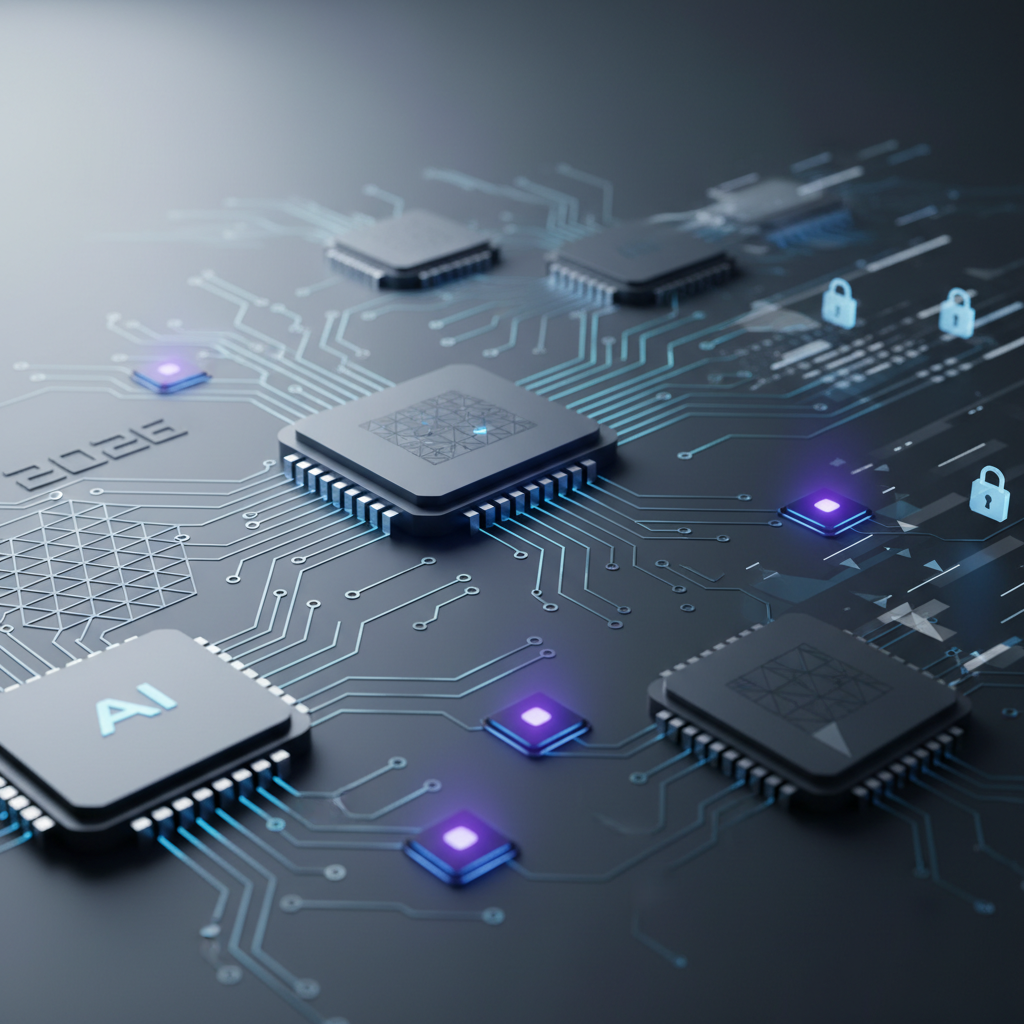
At its core, an edge AI chip is a specialized semiconductor designed to perform AI computations, particularly machine learning inference, directly on a device rather than sending data to a remote cloud server. These chips, often referred to as AI accelerators or neural processing units (NPUs), are optimized for efficiency, low power consumption, and high-speed processing of AI workloads. Unlike general-purpose CPUs or GPUs that might handle AI tasks in the cloud, edge AI chips are purpose-built for the unique demands of on-device AI.
The importance of these chips cannot be overstated. They address critical limitations inherent in cloud-based AI: latency, bandwidth, privacy, and reliability. Imagine an autonomous car needing to make a split-second decision based on real-time sensor data. Sending that data to the cloud, waiting for processing, and receiving a command back is simply too slow and unreliable. AI at the edge ensures that decisions are made instantaneously, locally, and securely. Our analysis suggests that this immediate processing capability is not just a convenience but a safety and efficiency imperative for many emerging applications.
Furthermore, data privacy is a growing concern for consumers and regulators alike. Processing sensitive personal data or proprietary industrial information directly on the device significantly reduces the risk of data breaches and complies with stricter data protection regulations like GDPR. This local processing capability is a cornerstone of trust in the age of pervasive AI. [Related: Data Privacy]
How Edge AI Chips Work: Architectures Driving Innovation
Edge AI chips are engineered with specific architectures to excel at AI tasks. While traditional processors rely on sequential instruction execution, AI workloads, especially neural network inference, benefit immensely from parallel processing. This is where the specialized design of edge AI hardware truly shines.
Most edge AI chips incorporate dedicated hardware blocks like NPUs (Neural Processing Units) or DSPs (Digital Signal Processors) alongside traditional CPU cores. These blocks are optimized for matrix multiplications and convolutions, the mathematical backbone of deep learning. For instance, an NPU might feature thousands of tiny arithmetic logic units (ALUs) working in parallel to rapidly compute neural network layers. This allows for significantly higher operations per second (OPS) at much lower power consumption compared to a general-purpose CPU trying to achieve the same task.
Leading chip manufacturers are exploring various architectural approaches:
- Custom ASICs (Application-Specific Integrated Circuits): These are chips designed from the ground up for a specific AI task or set of tasks. They offer the highest performance and energy efficiency for their intended purpose but are expensive to develop and less flexible. Examples include Google's Edge TPU or certain custom chips found in Apple's A-series processors.
- Optimized NPUs/Accelerators: Many mainstream SoC (System on Chip) providers, like Qualcomm and MediaTek, integrate dedicated NPUs into their mobile processors. These are highly optimized for common AI models, offering a balance of performance, flexibility, and cost-effectiveness. They often feature configurable processing units that can adapt to different neural network architectures.
- Low-Power GPUs: While often associated with cloud AI, scaled-down, highly efficient GPUs are also finding their way into edge devices, particularly where more complex vision or graphics-intensive AI tasks are required. NVIDIA's Jetson platform is a prime example of this approach for embedded systems.
These architectures enable on-device AI to perform tasks like real-time object detection, natural language processing, voice recognition, and predictive maintenance without relying on constant cloud connectivity. The ability to perform complex machine learning inference locally is a game-changer for countless applications.
The Real-World Impact: Consumer Electronics and Industrial IoT
The proliferation of edge AI chips is evident across diverse sectors, transforming everything from our personal gadgets to vast industrial complexes.
Consumer Electronics: Smarter, Faster, More Private
In our daily lives, edge AI chips are making smartphones, smart speakers, and wearables profoundly more intelligent. Consider the advancements in smartphone photography: real-time scene recognition, advanced computational photography features like portrait mode and night mode, and even video enhancement are all powered by on-device AI. Voice assistants respond faster because much of the initial speech processing happens locally, reducing latency. Facial recognition for unlocking devices or secure payments relies heavily on the immediate processing capabilities of these chips, bolstering both speed and security.
Key Takeaways
- •This article covers the most important insights and trends discussed above
Sources & References
TrendPulsee
Tech journalist and content creator