Hyper-Personalized Streaming: Beyond Basic Recommendations
In the ever-evolving landscape of digital entertainment, the concept of "personalization" has long been a buzzword. From curated playlists to suggested shows, streaming services have strived to make our viewing experience feel tailor-made. But as we stand in February 2026, the industry is hurtling past mere recommendations into an era of true hyper-personalized streaming. This isn't just about what you watch next; it's about how you watch it, what you see within it, and even who is creating it.
At TrendPulsee, our analysis suggests this shift is profound, fundamentally altering content creation, distribution, and consumption. We're witnessing a convergence of advanced AI, granular user data, and innovative content delivery mechanisms that promise an unprecedented level of viewer engagement. But what exactly does this mean for the future of streaming, and are we ready for an entertainment world that knows us better than we know ourselves?
What is Hyper-Personalized Streaming?
Hyper-personalized streaming represents the next frontier in content delivery, moving beyond traditional recommendation engines to create truly unique and dynamic viewing experiences for each individual user. While standard personalization might suggest a show based on your watch history, hyper-personalization delves deeper, potentially altering elements within the content itself, customizing interfaces, or even generating bespoke narratives based on real-time user interaction and biometric data.
This sophisticated approach leverages machine learning and AI algorithms to analyze vast datasets – not just what you watched, but how you watched it: your pausing habits, scenes you replayed, emotional responses captured via smart devices, and even your social media sentiment around specific genres. The goal is to anticipate desires and deliver content that resonates on an almost subconscious level, making the streaming experience truly one-of-a-kind. It's about crafting an individual journey, not just offering a menu.
How AI Personalizes Streaming Content?
AI is the engine driving this revolution. Beyond simple collaborative filtering (e.g., "people who watched X also watched Y"), advanced AI in streaming employs deep learning models to understand complex user preferences and content attributes. Here’s how it works:
- Behavioral Analytics: AI tracks every micro-interaction – scroll speed, click patterns, time spent on thumbnails, even fast-forwarding through certain types of scenes. This creates a detailed behavioral profile.
- Content Tagging & Analysis: Sophisticated AI can analyze content frame-by-frame, identifying objects, themes, emotional tones, and narrative structures. This allows for incredibly granular matching with user preferences.
- Dynamic Content Adaptation: This is where it gets truly exciting. AI can facilitate adaptive streaming content. Imagine a sports broadcast where the commentary language changes based on your location, or a drama where minor plot points or character arcs subtly shift to align with your preferred narrative styles. Netflix's experiments with interactive narratives like Bandersnatch were an early, manual foray into this, but AI is making such adaptivity scalable and automatic.
- Predictive Modeling: AI predicts not just what you might like, but when you'll want to watch it, and in what mood. This enables proactive content suggestions and even dynamic scheduling of personalized channels.
- Generative AI Integration: While still nascent, the integration of generative AI could eventually allow for the creation of entirely new scenes, character dialogue, or even short-form content segments tailored to individual tastes, pushing beyond streaming recommendations into true content generation.
Why Hyper-Personalization is Crucial for Streaming's Future
The streaming market is saturated. In 2025, reports indicated that the average US household subscribed to over 5 streaming services, with churn rates remaining a significant challenge for providers (Deloitte, 2025). In this fiercely competitive environment, differentiation is paramount. Hyper-personalized streaming offers a powerful competitive edge by fostering deeper engagement and loyalty.
"The battle for eyeballs isn't just about exclusive content anymore; it's about the exclusive experience," says Dr. Evelyn Reed, a media psychologist and consultant for major tech firms. "If a platform can make you feel like it truly understands you, anticipating your entertainment needs before you even articulate them, you're far less likely to cancel that subscription. It moves from a transactional relationship to an almost symbiotic one." (Related: subscription economy)
Beyond retention, hyper-personalization unlocks new monetization opportunities. Dynamic ad insertion, for instance, can deliver highly relevant advertisements to individual viewers in real-time, significantly increasing their effectiveness and value for advertisers. Imagine seeing an ad for a local restaurant just as a character in your show mentions craving a similar cuisine – that’s the power of contextually aware, hyper-personalized advertising.
The Evolution: Beyond Streaming Recommendations
We've all grown accustomed to the "Recommended for You" rows on our streaming dashboards. But the future of streaming evolves far beyond these static suggestions. Here’s a glimpse of what's emerging:
Interactive Narratives and Adaptive Storytelling
This is perhaps the most exciting frontier. Instead of a fixed narrative, viewers might influence plot points, character decisions, or even the ending of a story. While early examples were linear (choose A or B), AI-driven systems could allow for far more complex, branching narratives that adapt subtly based on a user's cumulative choices and preferences over time. Imagine a detective series where the culprit changes based on your historical preference for certain archetypes, or a comedy where the punchlines are tweaked to match your specific sense of humor.
AI-Curated Channels and Dynamic Interfaces
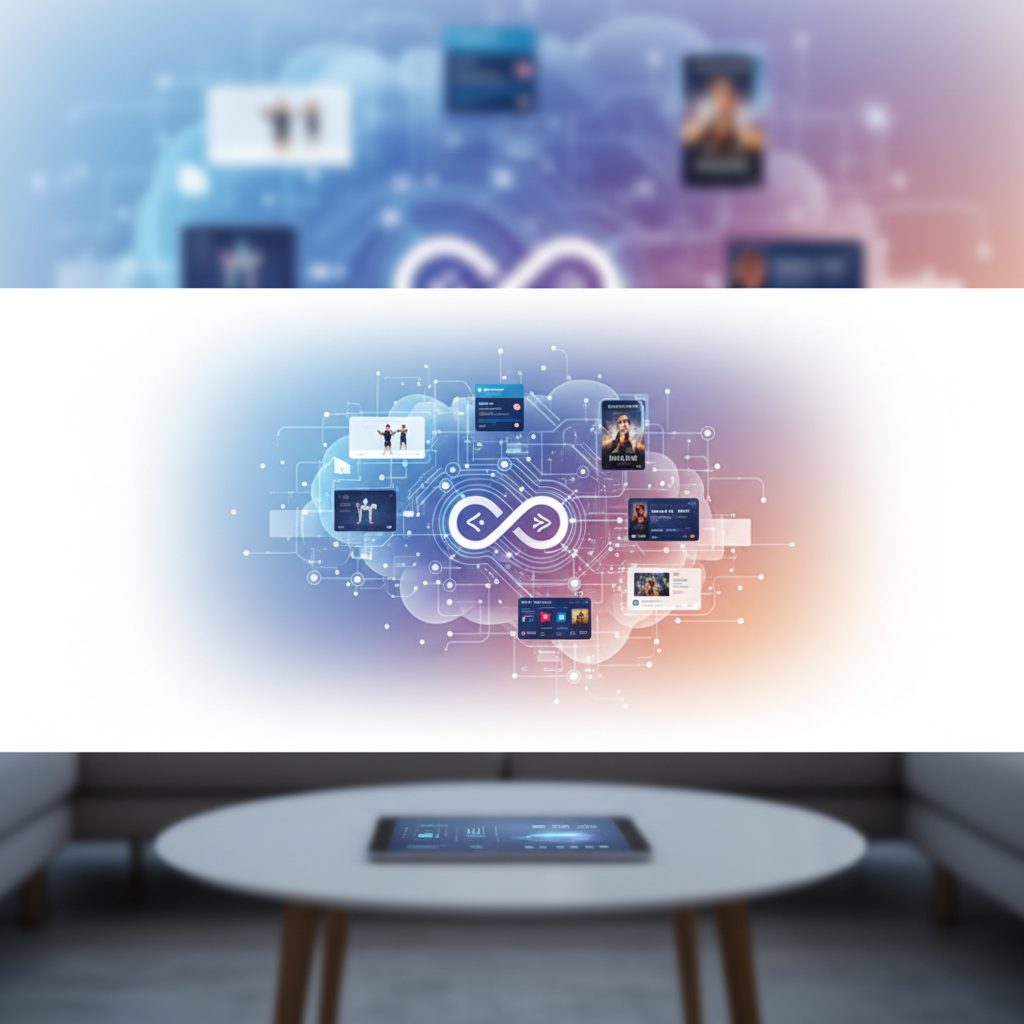
Forget the traditional grid of content. Picture a streaming service that generates a live, personalized channel just for you, blending clips from different shows, movies, and user-generated content into a seamless stream based on your real-time mood and activity. The interface itself could adapt, highlighting certain genres when you typically watch them, or changing its aesthetic based on your viewing habits. This is the ultimate streaming experience customization.
Content Remixing and Generative Personalization
This is where the line between consumption and creation blurs. AI could potentially remix existing content elements – different soundtracks, alternative camera angles, or even minor character appearances – to create a version of a show or movie uniquely suited to your taste. Further down the line, generative AI might even create short, bespoke content segments on demand, filling gaps in your viewing schedule with perfectly tailored micro-entertainment. (Related: AI content generation)
Navigating the 'Filter Bubble' and Niche Discovery
The rise of hyper-personalized streaming naturally raises questions about the 'filter bubble' effect. If AI is constantly feeding us content perfectly aligned with our existing preferences, are we at risk of becoming isolated in our own echo chambers, never encountering diverse perspectives or challenging new ideas? It's a valid concern.
Major platforms are acutely aware of this. While the primary goal is engagement, fostering discovery is also key. Netflix, for example, has long used algorithms that balance exploitation (giving you more of what you like) with exploration (introducing you to new genres or creators). Our conversations with industry insiders suggest that next-gen streaming platforms are building in mechanisms to intentionally break the bubble, albeit subtly. This might involve:
- 'Curiosity Nudges': AI might occasionally present content slightly outside your comfort zone, framed as a 'wildcard' or 'something surprisingly similar to X, but different'.
- 'Shared Experience' Prompts: Highlighting content that is trending broadly, or popular among your social connections, even if it doesn't perfectly fit your profile.
- 'Perspective Swaps': In interactive narratives, offering choices that lead to outcomes you might not typically choose, encouraging empathy or different viewpoints.
Conversely, hyper-personalization is a boon for niche content discovery. For independent creators or those producing highly specialized content, AI can act as a powerful matchmaker, connecting their work directly with the precise audience most likely to appreciate it, bypassing the need for broad marketing campaigns. This could democratize content distribution and lead to a flourishing of diverse, high-quality niche productions.
The Tech Powering This Transformation
The backbone of hyper-personalized streaming relies on several cutting-edge technologies:
- Advanced Machine Learning & Deep Learning: For pattern recognition, predictive analytics, and content generation.
- Cloud Computing: To handle the immense data processing, storage, and real-time delivery required for billions of personalized streams.
- Edge Computing: To process data closer to the user, reducing latency for highly interactive or adaptive content.
- Biometric Sensors & Wearables: While controversial for privacy, these could provide real-time emotional and physiological data to further refine personalization (e.g., adjusting content pace if a viewer's heart rate suggests boredom).
- 5G and Beyond: High-bandwidth, low-latency networks are essential for delivering dynamic, high-quality adaptive content without buffering or delays.
Companies like Google's DeepMind, Amazon Web Services (AWS), and NVIDIA are investing heavily in the AI and infrastructure required to make this vision a reality. We're seeing major streaming players like Disney+, Max, and even YouTube Premium experimenting with more sophisticated personalization layers, moving beyond simple recommendations to dynamic content suggestions based on time of day, device, and even social context.
Key Takeaways
- Hyper-personalized streaming goes beyond recommendations, offering dynamic, adaptive, and even interactive content experiences tailored to individual users.
- AI is the core enabler, using advanced analytics, predictive modeling, and potentially generative capabilities to customize every aspect of the streaming journey.
- This evolution is crucial for viewer engagement, retention, and new monetization strategies in a saturated market.
- The future includes interactive narratives, AI-curated live channels, and content remixing.
- While concerns about 'filter bubbles' exist, platforms are developing strategies to balance personalization with content discovery.
- Underlying technologies include advanced AI, cloud/edge computing, and high-speed networks.
The Future of Entertainment is Personal
The trajectory is clear: the future of entertainment is deeply personal. Hyper-personalized streaming isn't just a technological fad; it's a fundamental shift in how we interact with stories and media. While ethical considerations around data privacy and the potential for 'filter bubbles' will undoubtedly remain central to the conversation, the promise of an entertainment landscape that truly understands and caters to individual tastes is undeniably compelling.
As tech journalists at TrendPulsee, we believe this era will empower creators to reach highly specific audiences and offer viewers an unprecedented level of immersion and choice. The days of one-size-fits-all entertainment are rapidly fading, replaced by a bespoke, ever-evolving digital tapestry woven just for you. Get ready for a streaming experience that feels less like watching TV and more like living within the story itself. This is the next-gen streaming we've been waiting for, and it's only just beginning to unfold.
Key Takeaways
- •This article covers the most important insights and trends discussed above
Sources & References
TrendPulsee
Tech journalist and content creator