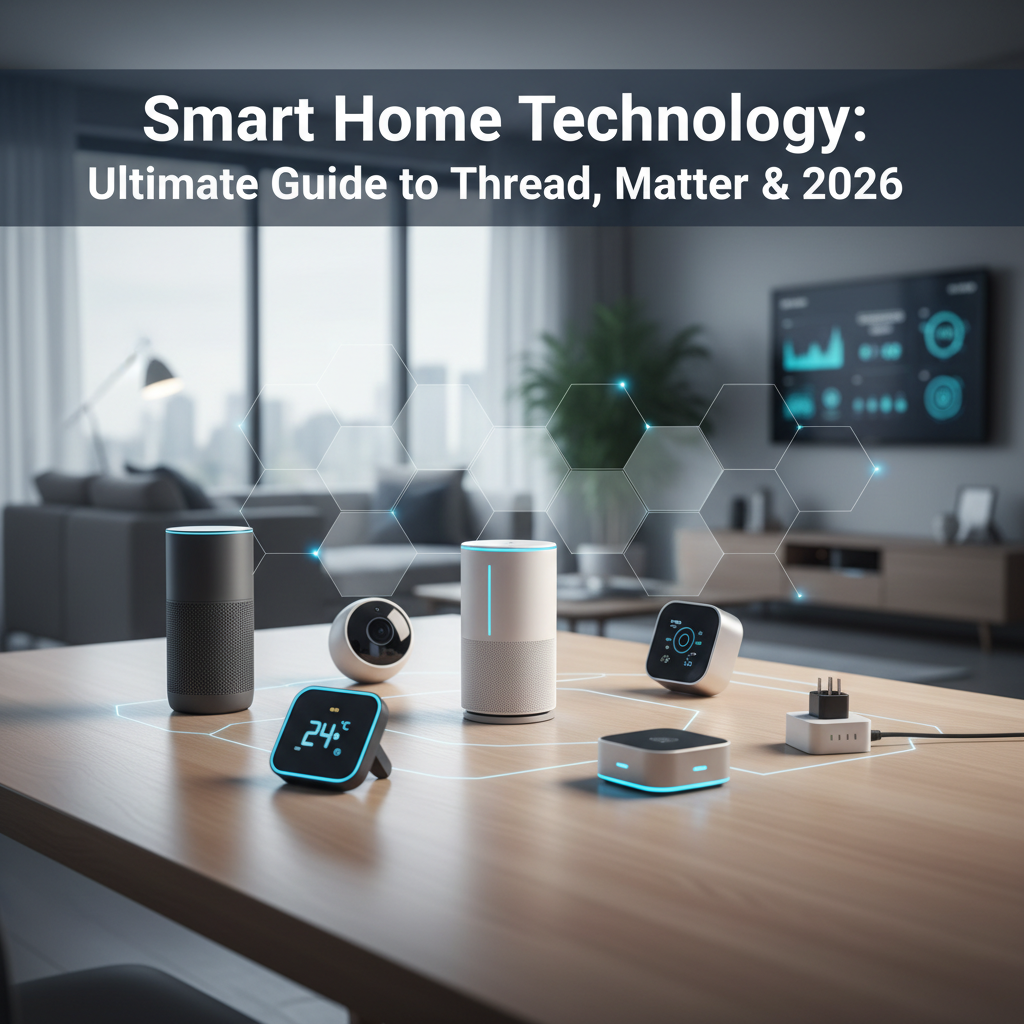
Smart Home Technology: The Ultimate Guide to Thread, Matter, and Connected Living in 2026
TL;DR: Quick Summary
- Thread and Matter are here: These new protocols are solving long-standing interoperability issues in smart home technology.
- Seamless Integration: Expect easier setup, more reliable connections, and cross-platform compatibility for your smart devices.
- Ecosystem Showdown: Apple Home, Google Home, and Amazon Alexa are all embracing these standards, but with nuanced benefits.
- Future-Proofing: Adopting Thread and Matter now means your smart home is ready for the next decade of innovation.
Imagine a world where every smart device in your home, regardless of brand, speaks the same language. A world where setting up a new gadget is as simple as plugging it in, and your entire connected living environment responds instantly, reliably, and securely. This isn't a futuristic fantasy; it's the present reality rapidly unfolding thanks to groundbreaking advancements in smart home technology, particularly with the widespread adoption of Thread and Matter protocols. As of early 2026, these standards are not just buzzwords – they are the bedrock of what we at TrendPulsee are calling Smart Home 3.0.
The smart home market, projected to reach a staggering $195 billion globally by 2026 [Source 1], has long been plagued by fragmentation. Different brands, different apps, and frustrating compatibility issues have been a constant headache for consumers. But with Thread providing a robust network layer and Matter offering a universal application layer, the era of true interoperability is finally upon us. Our analysis suggests this shift will not only simplify the user experience but also accelerate innovation, making smart homes more accessible and powerful than ever before.
What is Thread in Smart Home Technology and Why Does it Matter?
Thread is a low-power, wireless mesh networking protocol designed specifically for smart home devices. Unlike Wi-Fi, which can be power-hungry and less reliable for small devices, or Bluetooth, which has limited range, Thread creates a self-healing mesh network where every device can communicate with each other, extending the network's reach and robustness. This means if one device goes offline, others can reroute their communication, ensuring your smart home technology remains responsive.
How will Thread and Matter change smart homes? Thread provides the underlying, super-efficient communication highway that Matter-enabled devices use to talk to each other. It's built for reliability, security, and low power consumption, making it ideal for battery-powered sensors, smart lights, and locks. Devices like Apple HomePod mini, Google Nest Hub, and Amazon Echo (4th Gen) already act as Thread Border Routers, bridging your Thread network to your Wi-Fi network and the internet. This foundational technology is crucial for the seamless, instantaneous responses we expect from modern home automation. Read more: Energy Efficient Smart Homes [blocked]
Key Advantages of Thread Networking
- Self-Healing Mesh: If one device fails, the network automatically finds another path.
- Low Power Consumption: Ideal for battery-operated devices, extending their life significantly.
- High Reliability: Dedicated for IoT, reducing congestion common on Wi-Fi.
- Future-Proof: Designed with security and scalability in mind for the growing number of connected devices.
How Does Matter Protocol Work and Why is it Important for Smart Home?
Matter is an open-source, royalty-free connectivity standard that works over various network technologies, including Thread, Wi-Fi, and Ethernet. Its primary goal is to enable smart home devices from different manufacturers to communicate with each other locally, securely, and reliably, regardless of the ecosystem they belong to. Think of Matter as the universal translator for your smart home.
Why is Matter important for smart home? Matter addresses the fundamental problem of fragmentation. Previously, a Philips Hue bulb might not easily talk to a Samsung SmartThings hub without complex integrations or specific bridges. With Matter, a single device can be set up once and then controlled by any Matter-compatible platform – be it Apple Home, Google Home, Amazon Alexa, or Samsung SmartThings. This dramatically simplifies device setup and management, reduces the need for multiple apps, and enhances user choice. It's a game-changer for connected living technology, fostering an environment where innovation thrives on compatibility rather than proprietary lock-ins.
Matter's Impact on Device Interoperability
- Universal Compatibility: A single device works across multiple ecosystems.
- Simplified Setup: Scan a QR code, and the device is ready to integrate.
- Local Control: Devices can communicate directly within your home network, improving speed and reliability, even if the internet is down.
- Enhanced Security: Built-in security features protect your data and privacy.
The Ecosystem Showdown: Thread & Matter in Apple Home, Google Home, and Amazon Alexa
With Thread and Matter becoming the new standard, major smart home ecosystems are rapidly adapting. Each offers a slightly different flavor of integration and benefits, catering to their existing user bases.
| Feature/Ecosystem | Apple Home (HomeKit) | Google Home | Amazon Alexa |
|---|---|---|---|
| Thread Support | Excellent (HomePod mini, Apple TV 4K) | Excellent (Nest Hub Max, Nest Wifi Pro) | Good (Echo 4th Gen, Echo Show 8/10 3rd Gen) |
| Matter Controller | Yes, fully integrated | Yes, fully integrated | Yes, fully integrated |
| Setup Experience | Very smooth, intuitive | Smooth, integrated with Google Assistant | Improving, integrated with Alexa app |
| Device Compatibility | Expanding rapidly | Expanding rapidly | Expanding rapidly |
| Privacy Focus | High | Moderate to High | Moderate |
| Automation Capabilities | Powerful, visual | Powerful, routine-based | Powerful, routine-based |
| Unique Benefits | Tight iOS integration, strong privacy | Deep Google services integration, AI | Broad device support, voice-first |
Apple Home: Apple has been an early and strong proponent of Thread and Matter. Their HomePod mini and latest Apple TV 4K models serve as Thread Border Routers and Matter controllers, offering a seamless and highly secure experience for iOS users. The setup process is typically straightforward, often involving just scanning a QR code. Apple's focus on privacy and user experience makes it a compelling choice for those already invested in the Apple ecosystem. We've seen a significant uptick in Matter-enabled devices appearing directly in the Home app, simplifying the user journey immensely. Read more: IoT Device Privacy Concerns [blocked]
Google Home: Google has also embraced these standards wholeheartedly, with devices like the Nest Hub Max, Nest Wifi Pro, and newer Nest speakers acting as Thread Border Routers and Matter controllers. Google's strength lies in its AI and Assistant capabilities, which are now extending to a more unified smart home experience. The integration of Matter means that devices previously siloed can now be controlled via Google Assistant, enhancing the power of routines and voice commands. Expect Google to leverage its AI prowess to make your smart home even more proactive and intelligent.
Amazon Alexa: Amazon, with its vast array of Echo devices, has been actively updating its ecosystem to support Thread and Matter. The Echo (4th Gen) and newer Echo Show devices function as Thread Border Routers and Matter controllers. While Amazon's ecosystem has historically been more open to various brands, Matter solidifies this approach, allowing for even broader device compatibility and simplified integration. Alexa's strength remains its ubiquitous voice control and extensive skill library, which will only become more powerful with a truly interoperable foundation.
Upgrading Your Smart Home: A DIY Guide to Thread & Matter Adoption
Transitioning to a Thread and Matter-enabled smart home doesn't have to be daunting. Here's a practical guide:
- Identify Your Hub: Check if you already own a Thread Border Router/Matter Controller. Devices like Apple HomePod mini, Google Nest Hub (2nd Gen or newer), Google Nest Wifi Pro, Amazon Echo (4th Gen), or Samsung SmartThings Hub v3 are common examples. If not, consider purchasing one as your central brain.
- Start with New Devices: When buying new smart devices, prioritize those explicitly labeled
Key Takeaways
- •This article covers the most important insights and trends discussed above
Sources & References
TrendPulsee
Tech journalist and content creator